
Is the Las Vegas Housing Market Crashing? Here’s What the Data Shows
Scroll through social media long enough, and you’ll probably come across someone warning that a housing crash is right around the corner. Some of those headlines can sound pretty convincing.
But the latest housing data tells a more nuanced story.
Home prices climbed 2.1% across the country over the past year. I’m looking at where prices are rising the fastest, at the state and city levels, and where they’re falling. And the National Association of Home Builders (NAHB) put out some maps that show exactly what’s going on.
You’ll see those below, along with state and city rankings on home price growth and what we’re seeing here in Las Vegas, so you can make an informed decision on whether to buy or sell this year.
What's Happening to Home Prices Right Now
According to the Federal Housing Finance Agency (FHFA), home prices are up 2.1% nationally compared to a year ago.
This is a little faster than the pace at the start of the year.
Prices also rose 0.3% since the first few months of this year. This slower pace suggests the market is settling into a steadier rhythm.
Home prices have gone up every single quarter since 2012. Even with higher mortgage rates and cost pressures over the past few years, prices have kept climbing in most of the country.
States Where Home Prices Are Rising (or Falling) the Fastest
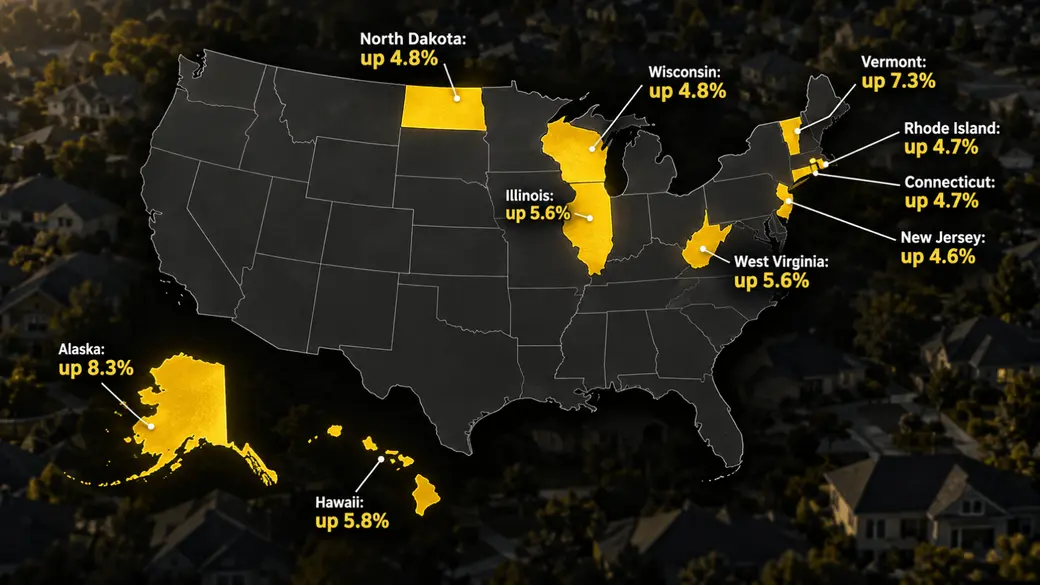
Some states are seeing much bigger gains than others. Here are the ten states with the strongest price growth over the past year:
-
Alaska: up 8.3%
-
Vermont: up 7.3%
-
Hawaii: up 5.8%
-
Illinois: up 5.6%
-
West Virginia: up 5.6%
-
Wisconsin: up 4.8%
-
North Dakota: up 4.8%
-
Connecticut: up 4.7%
-
Rhode Island: up 4.7%
-
New Jersey: up 4.6%
A lot of these states are in the Midwest or Northeast, where there aren't enough homes for sale to keep up with buyer demand, and that keeps prices climbing.
Home prices fell in four states over the same year:
-
New Mexico: down 1.2%
-
Washington: down 0.9%
-
Colorado: down 0.5%
-
California: down 0.2%
A handful of other states, including Oregon, North Carolina, Texas, Mississippi, and Arizona, saw prices grow by less than 1% for the year. Many of these are the same markets that saw explosive growth during the pandemic, and they're cooling off now.
Cities Where Home Prices Are Rising (or Falling) the Fastest
City-level numbers show even bigger swings than the state data. Here are the ten cities with the biggest price gains over the past year:
-
Elgin, IL: up 7.7%
-
Allentown-Bethlehem-Easton, PA-NJ: up 7.0%
-
Bridgeport-Stamford-Danbury, CT: up 6.6%
-
Charleston-North Charleston, SC: up 6.5%
-
El Paso, TX: up 6.5%
-
Milwaukee-Waukesha, WI: up 6.1%
-
Chicago-Naperville-Schaumburg, IL: up 5.9%
-
New York-Jersey City-White Plains, NY-NJ: up 5.6%
-
Newark, NJ: up 5.5%
-
Greensboro-High Point, NC: up 5.3%
Some of these cities sit in states that didn't make the state-level top ten, which shows how much prices can vary within a single state.
These ten cities saw the biggest price drops over the same year:
-
Everett, WA: down 3.7%
-
San Antonio-New Braunfels, TX: down 3.0%
-
Bakersfield-Delano, CA: down 2.6%
-
Seattle-Bellevue-Kent, WA: down 2.4%
-
San Francisco-San Mateo-Redwood City, CA: down 2.4%
-
Tucson, AZ: down 2.2%
-
Albuquerque, NM: down 1.7%
-
San Jose-Sunnyvale-Santa Clara, CA: down 1.6%
-
Washington, DC-Maryland: down 1.0%
-
Denver-Aurora-Centennial, CO: down 1.0%
A lot of these cities are in the West, in some of the same markets that saw the fastest growth a few years ago.
Some cities look very different depending on the time frame you use. San Francisco's prices dropped 9.1% compared to the previous few months, even though its year-over-year drop was a smaller 2.4%. Short-term numbers can jump around a lot, so the year-over-year comparison gives a better sense of what's happening.
Why Some Markets Are Heating Up and Others Are Cooling Off
Two things are driving most of what we're seeing in this data.
#1. Affordability
Buying a home costs more than it used to, and that's pricing some buyers out or pushing them to wait. This is most visible in expensive markets like California and parts of the Pacific Northwest, where prices have already climbed a lot over the past several years.
#2: Housing supply
In a lot of Midwest and Northeast markets, there aren't enough homes for sale to meet buyer demand. When supply is tight, prices tend to hold steady or keep climbing.
This helps explain why states like Illinois and Wisconsin keep appearing near the top of the growth list. States like Oregon and Arizona are dealing with a different set of pressures. Prices climbed fast in these places during the pandemic, and affordability still hasn't caught up.
What’s Happening With Home Prices in Las Vegas?
Las Vegas is actually performing somewhat better than the national number. According to the FHFA House Price Index, home prices in the Las Vegas–Henderson–North Las Vegas metro area were up 2.77% year over year in the second quarter of 2026, compared with a 2.13% increase nationally.
That’s an important distinction because headlines about the national housing market—or even other Western states—don't necessarily describe what is happening here in Las Vegas.
Price growth has certainly slowed from the rapid appreciation we experienced in previous years, but slower appreciation and falling home values are not the same thing. The latest FHFA data still shows Las Vegas home prices higher than they were a year ago.
For sellers, that makes realistic pricing increasingly important. Buyers have more choices and are paying closer attention to condition, location and value. For buyers, a more balanced market can mean more time to evaluate a property and potentially more negotiating room than during the highly competitive markets of recent years.
With two decades of experience selling real estate in Las Vegas, I've seen our market move through very different cycles. National headlines can provide context, but when you're deciding whether to buy or sell, the numbers in your particular neighborhood and price range matter much more.
If you're wondering what your home is worth—or whether now is the right time to buy—I'm happy to help you look at what's happening in your specific part of the Las Vegas Valley.